


Hay is a staple food for equids. It provides a high-quality fiber source in their diet. The text below explains everything you need to know about hay for equids:
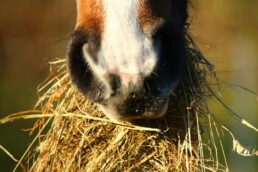
Hay is cut and dried grass, usually composed of different varieties of grasses and legumes. It is harvested when the plants are at an optimal stage of maturity and is then dried to reduce its moisture content.
Why do equids need hay?
Equids need hay for several reasons. First, it provides a source of dietary fiber that is essential for healthy digestion. Fiber helps prevent digestive problems such as colic and contributes to the proper functioning of the digestive system. Additionally, hay can also help maintain an adequate body weight in horses and donkeys that tend to gain weight easily.
What type of hay is best for equids?
The type of hay recommended for equids depends on their individual needs. In general, good quality hay should be clean, free from excessive dust, and mold-free. It is best to choose hay that contains a good proportion of grasses and legumes to ensure a balanced nutrient intake.
How to feed hay to equids?
Hay can be fed to equids in various ways. It can be offered loose in an appropriate feeder that allows horses to pull out the strands of hay and eat them at will. It can also be offered in the form of hay nets, which helps ration hay consumption and prevent gluttony, waste, and dust inhalation.
View our range and prices here
Advantages of hay compared to grass:
– Storage: Hay can be stored for long periods without deteriorating, making it a reliable forage source throughout the year.
– Nutritional Value: Hay generally contains a higher fiber content than fresh grass, which can be beneficial for animals’ digestive systems. It can also provide a constant supply of essential nutrients throughout the year.
Disadvantages of hay compared to grass:
– Lower energy and protein values: Fresh grass generally has a higher energy and protein value than hay.
– Variable nutritional quality: The nutritional quality of hay can vary depending on various factors, such as harvest time, climatic conditions, etc. Therefore, it is important to ensure that the chosen hay has adequate nutritional value for the animals. In comparison, fresh grass generally available in nature is more consistent in terms of nutritional value.
– unlike grass, hay is a source of dust. There can be dust in hay for several reasons. First, during hay harvesting and drying, particles of soil, pollen, mold, and other allergens can mix with the hay. Additionally, if hay is stored in humid conditions, there can be an increase in mold and dust. When hay is stirred or handled, these particles are released into the air, which can cause respiratory problems (allergies, emphysema, etc.) in equids. It is therefore important to ensure that horses do not root their noses in the hay. The hay net is a solution that addresses this problem.
Read our article on this topic here