


The horse is a herbivore; its digestive system is designed to eat continuously, or nearly so. However, depending on the housing—stall, paddock, or pasture/stall—and the recurring lack of grass in winter and now in summer, many owners wonder: how much hay should I give my horse each day? Too little, and the horse is exposed to boredom, digestive issues, and ulcers. Too much, and hay is wasted or weight gain is encouraged. Here is how to find the right amount and how a hay net helps you stick to it.
Basic needs: 1.5 to 2% of live weight
Forage is the foundation of a horse’s diet. It is generally considered that an adult horse needs 1.5 to 2% of its live weight in dry forage per day in summer, and closer to 3% in winter. This average obviously depends on the quality of the hay, the climate, the horse’s activity level, and any supplements provided (pellet rations, etc.). For a 500 kg horse, you can expect between 7.5 to 10 kg of hay per day. A 300 kg pony will consume closer to 4.5 to 6 kg.
These figures should be nuanced as mentioned previously. They vary according to hay quality (coarse, dry hay does not have the same value as rich, tender hay), breed, age, temperament, activity, and climate. If in doubt, especially for an overweight, elderly, or sick horse, seek advice from your veterinarian or an equine nutritionist.
See also our article: https://filetafoin.com/lalimentation-en-fourrage-des-chevaux/
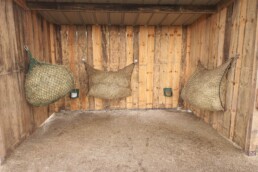
The hay net for horses: here, the bag-style net solution with multiple supply points to avoid conflicts between horses.
A benchmark based on weight and activity
Here is a table providing general guidelines for hay of decent quality, distributed as a full ration (without access to grass). Always adjust according to your horse’s body condition.
| Type of horse | Weight | Hay per day (benchmark) |
| Pony | 300 kg | 4.5 to 6 kg |
| Saddle horse | 500 kg | 7.5 to 10 kg |
| Draft horse | 700 kg | 10.5 to 14 kg |
For a horse at rest or in light work, the required amount of hay will be at the lower end of the range, while for a horse in work, it will be at the higher end (with appropriate supplementary feeding). A horse with access to grass will require less hay.
Special cases to monitor
Certain horses require special attention:
- Overweight horses or those prone to laminitis or EMS: the amount of hay must be reduced, while remaining vigilant about consumption time, as prolonged fasting is bad for the stomach. A small-mesh net (30mm) helps slow down hay intake and thus spreads the ration throughout the day. See our article: https://filetafoin.com/le-syndrome-metabolique-equin-sme/
- The senior horse: depending on the state of their teeth, they may have difficulty chewing hay that is too coarse. They therefore need high-quality, ad-lib hay. A 65 mm mesh net is ideal.
- Pregnant or lactating mares: their needs increase. Veterinary advice is recommended.
- The stabled horse at rest: Without occupation, they eat quickly and then spend hours with nothing to chew. Hay provided continuously limits boredom and behaviors such as stable vices or aggression, as well as digestive problems.
Ad-lib hay or measured ration: which to choose?
Ad-lib hay most closely matches the horse’s natural rhythm, as they need to chew continuously. However, horses do not always know how to self-regulate. For this, they need help with a hay net and an appropriate mesh size.
A measured ration allows for controlled intake, but it has a drawback: the horse finishes its hay in a few hours and then remains fasted until the next meal. We know today that long periods without forage are harmful.
Between the two, slow feeding is a good compromise: the same amount of hay, but consumed much more slowly. The horse eats for longer, more regularly, and the hay does not end up soiled in the bedding.
You can consult our article for more details: https://filetafoin.com/filet-et-slowfeeding/
How a hay net helps you respect the ration
A hay net does not change the amount of hay distributed, but it changes how it is consumed. The choice of mesh depends on the objective:
- 65 mm mesh: equivalent to ad-lib hay. It limits waste and dust inhalation without significantly slowing down food intake. Ideal for preventing waste and helping to prevent respiratory diseases.
- 45 mm mesh: has a slight slow-feeding effect. It prevents gluttony and waste, and is well-suited for slightly overweight horses. This is the most common mesh size.
- 30 mm mesh: high slow-feeding effect, to be reserved for horses already accustomed to nets and particularly for overweight horses or those with a pathology.
A net prevents waste by stopping the horse from trampling or scattering its hay: on average, a saving of about 30% of hay is observed. Feelnets are made of knotless polyester, a material that does not become rough, does not retain water, and does not freeze. They are OEKO-TEX Standard 100 Class I certified.
Practical tips for dosing your hay correctly
- Weigh your hay: a simple luggage scale is enough.
- Divide into several distributions: at least two to three per day, ideally with hay always available via a net. The simplest way is to find the net and mesh size that works best to minimize refilling while regulating hay consumption.
- Monitor body condition: a horse’s general condition is assessed by sight and touch (ribs, withers, croup). Adjust the ration according to their needs.
- Check hay quality: good smell, absence of mold and excessive dust. Dusty hay is bad for the respiratory tract. Moldy hay must be thrown away.
- Change gradually: any modification to the ration or type of hay should be done over several days.
FAQ: your questions about hay quantity
How much hay should be given to a horse per day?
On average, between 1.5 and 2% of its live weight in dry forage, which is 7.5 to 10 kg per day for a 500 kg horse. The exact amount depends on hay quality, activity, climate, and body condition.
How much hay per day for a pony?
For a 300 kg pony, count on about 4.5 to 6 kg of hay per day. Ponies gain weight easily: monitor their body condition and use a small-mesh net if necessary.
Can you give a horse ad-lib hay?
Yes, for many horses, this is the solution closest to their natural lifestyle. It is not suitable for greedy or overweight horses; a measured ration and slowed consumption via a net is preferred.
Does a hay net reduce the amount of hay consumed?
It slows down food intake and limits waste (about 30% hay saved on average), but it does not reduce the horse’s needs. Above all, it allows the ration to be spread throughout the day.
Which mesh size should I choose to slow down my horse?
The 45 mm mesh provides a slight slow-feeding effect, while the 30 mm mesh has a more pronounced effect (to be introduced gradually). The 65 mm mesh is suitable for ad-lib hay.
What should I do if my horse finishes its hay too quickly?
A small-mesh net is the primary solution. You can also divide the ration into several distributions. Our article on the greedy horse details the causes and solutions: https://filetafoin.com/cheval-glouton-pourquoi-mange-t-il-si-vite-et-comment-le-ralentir/
To go further: discover our range of hay nets, tested with veterinarians and equestrian center professionals, as well as our guide for choosing the right net size (https://filetafoin.com/choisir-taille-filet/). Free delivery in France, personalized quote in less than 3 hours.