


Why My Horse Is a Greedy Eater: The Conflict Between Nature and Captivity
Does your horse devour its hay ration in record time, and is it always on the lookout for the next meal? This ‘greedy horse’ behavior is common, but it’s not simply a sign of gluttony. It often originates from a mismatch between the domestic lifestyle imposed on them and equine physiology. In their natural state, horses spend nearly 16 hours a day grazing, continuously ingesting small amounts.
Stable life, with divided meals (often two or three a day), creates food anxiety. The horse eats quickly out of fear of scarcity, boredom, or a simple competitive instinct, even if it’s alone.
Life with unlimited access to loose hay offers an abundance of forage. The hay is easily accessible. The horse can grab very large mouthfuls without effort or resistance.
This ingestion speed is a direct response to a feeding rhythm that is not natural for them.
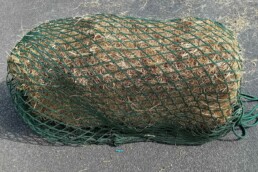
Here is an XL bundle hay net model. Allows for simple and quick handling for distributing hay in “small bale” format.
Health Consequences of Rapid Ingestion
This feeding behavior leads to serious health problems in horses.
First, the most immediate danger is “esophageal choke”: by swallowing large mouthfuls without sufficient chewing, the hay can get stuck.
But long-term consequences are more serious. A horse that eats too fast doesn’t chew enough and therefore produces less saliva. However, saliva is the only antacid the horse has to buffer the permanent acidity of its stomach. A meal swallowed in 30 minutes instead of 3 hours means an empty stomach for long periods, which promotes the development of gastric ulcers. Furthermore, this massive and rapid influx of food disrupts the entire digestive system, significantly increasing the risk of colic and promoting weight gain.
First Steps to Regulate Feeding Rhythm
Fortunately, there are solutions you can implement to help your horse regain a healthier and slower feeding rhythm. The first approach is to divide meals as much as possible to reduce fasting periods. However, this solution is complicated for horse owners to implement. You can also wet the hay, which forces the horse to sort more and slightly slows down intake.
However, the most effective solution is to mechanically influence the horse’s ability to grab its hay. This is the entire principle of “slow feeding” (or slow eating), to force the horse to take smaller mouthfuls at a time and thus eat more slowly, mimicking the horse’s natural behavior.
The Hay Net: The Best Slow Feeding Tool
The hay net stands out as the simplest, most economical, and most effective solution to combat the bulimic effect in horses. Specifically, a hay net that radically extends the hay ingestion time. The horse can no longer “grab” large tufts of forage; it must grasp the hay strand by strand. A meal that was previously devoured in 45 minutes can now be spread out over 3 or 4 hours. The benefits are twofold: not only is the ingestion time respected, but chewing is also increased. The horse therefore produces more saliva, protecting its stomach. Furthermore, this activity occupies its mind, combats boredom, and significantly reduces stress related to waiting for the meal.
Our tips for choosing the mesh size here https://filetafoin.com/ in the article “how to choose your mesh size”
Conclusion: Reconciling Digestive Health and Mental Well-being
In conclusion, a greedy horse is often just a horse whose lifestyle does not respect its fundamental physiology. Slowing down its ingestion speed is a true return to calm and digestive serenity. By using a suitable tool like the hay net, you are not just correcting a behavioral “flaw”; you are addressing a vital need. You offer your companion better digestive health, actively prevent the onset of serious pathologies like ulcers and colic, and improve its daily mental well-being.