


Choosing your hay net size
Here are some useful tips to help you choose the dimensions for your sheet-shaped, bag-shaped, and bundle-shaped hay nets.
The net’s shape depends on your habits and hay packaging.
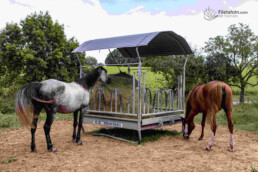
To determine the ideal size for a sheet-shaped hay net suitable for your hay rack, consider its dimensions and the height of the hay. Follow these steps:
- Measure the dimensions of the hay rack: Note the length and width.
- Measure the height of the hay rack where the net will be attached.
- Estimate the height of the hay once it is well compacted in the hay rack.
- Add the hay height or the net attachment height (take the larger of the two dimensions) to the width and length of the hay rack so the hay is accessible to the bottom.
- Choose the mesh size: Hay nets are available in different mesh sizes (30 mm, 45 mm, 65 mm). Choose the one that best suits your needs. Don’t hesitate to ask for our advice.
For example, if your hay rack measures 2 m x 4 m and is 60 cm high, opt for a net with dimensions 2.60 m x 4.60 m.
If you need help, we are here to assist you by phone, email, or WhatsApp. 😉 contact
To calculate the size of a bag-shaped hay net based on your habits and needs:
Number of horses to feed
- Know the hay consumption of each horse and choose the net size accordingly.
- Multiple horses: consider a larger net to hold a greater quantity of hay and prevent horses from jostling. Or ideally, multiple nets.
Refill frequency
- Daily refilling: A medium-sized net is suitable.
- Less frequent refilling: Opt for a larger net to store more hay at once.
Mesh size
- Choose a mesh size that will slow down hay consumption without making access too difficult for the horses. Smaller meshes (around 3 cm) for maximum slowing, larger meshes (around 65 cm) for easier access.
here is a general equivalence between the size of bag-shaped hay nets and the weight of hay they can hold:
- Small nets (1 m x 0.90 m): They can generally hold between 7 to 10 kg of hay.
- Medium nets (1.50 m x 1 m): These nets can hold between 11 to 16 kg of hay.
- Large nets (2 m x 1 m): They can hold between 18 to 21 kg of hay.
Capacities may vary depending on hay density and mesh size. Nevertheless, this provides a general idea to help you choose the right hay net.
If you need help, we are here to assist you by phone, email, or WhatsApp. 😉 contact
Choosing your bundle-shaped hay net:
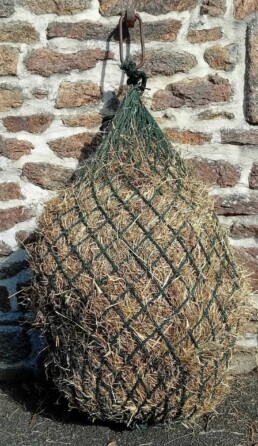
The capacity of the bundle net M is 8 to 10 kg of hay.
The capacity of the bundle net XL is equivalent to an entire hay bale (95 x 50 x 35 cm)

Key Features of Feelnets Hay Nets
Premium Quality
Purchasing a Feelnets hay net offers several unique advantages that set it apart from other options on the market.
- High-Quality Materials: Feelnets are made from premium polyester, ensuring exceptional durability and strength.
- Certified: Feelnets hay nets are certified according to OEKO-TEX Standard 100 Class I. This means they contain no harmful substances, thus ensuring the safety and well-being of your horses. This certification is a guarantee of quality and trust, assuring you that the nets are made with safe and environmentally friendly materials. Feelnets hay nets are also recyclable.
- UV Resistance: Unlike some nets, Feelnets hay nets are resistant to ultraviolet rays, which prevents premature degradation.
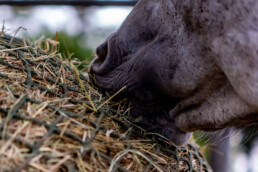
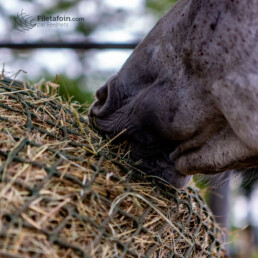
Our polyester nets will remain soft over time, protecting the gums, teeth, and whiskers of equids.
Comfort for Horses
- Softness and Flexibility: Feelnets hay nets are designed to be soft and flexible, minimizing the risk of injury to horses’ gums and lips. This also prevents whiskers from being cut.
- Even Hay Distribution: The net design allows for even hay distribution (no fractional meals), encouraging slower, more natural feeding, which is beneficial for horses’ digestion.
Ease of Use
- Lightweight: Feelnets are lightweight, making them easy to install and transport.
- Easy Maintenance: They are easy to clean and maintain, and can be washed by hand, with a pressure washer, or in a machine.
Commitment to Customer Satisfaction
-
- Responsive Customer Service: Feelnets offers excellent customer service, ready to answer all your questions and assist you when needed.
- Satisfaction Guarantee: Feelnets often offers satisfaction guarantees or flexible return policies, ensuring you can purchase with confidence.
By choosing Feelnets, you are opting for a reliable, durable product designed with your horses’ well-being in mind.
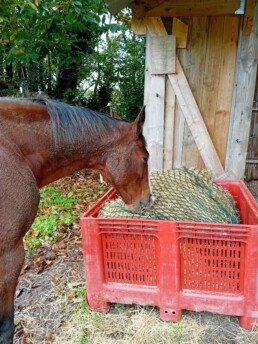
The Special Palox Hay Net
An Essential Tool for Feeding Horses
The Special Palox Hay Net is an essential tool for equine breeders and owners who wish to use a Palox or a wooden crate as a hay feeder. This system is practical, simple, and efficient. This net has been specially designed to fit the dimensions of Paloxes, these large crates typically used for storing and transporting harvests.
There are different types of Paloxes: wood, plastic, and metal.
Advantages of the Special Palox Hay Net Design
One of the advantages of the Special Palox Hay Net is its ability to keep hay securely in place. Its design, featuring mesh of varying tightness, prevents material loss and waste, while also ensuring good hay aeration. Furthermore, this net is durable and resistant, making it suitable for intensive use.
Organization and Safety
The Special Palox Hay Net promotes organized and optimized forage distribution for equines. It also simplifies hay loading. Thanks to its attachment system, it can be securely fastened to the sides or bottom of the crate, ensuring equine safety. Moreover, its installation is quick and easy, saving time during hay net filling operations. Its size is specifically designed to prevent overflow outside the feeder once filled, thus avoiding any accidents.
Health Benefits for Horses
Feeding hay to horses in a Palox or wooden crate offers several advantages. Firstly, it helps limit hay waste. The hay remains clean and dry, as it is not in direct contact with the ground, which reduces the risk of contamination by dust or droppings. Adding a Special Palox Hay Net provides additional benefits. The net slows down hay consumption, extending chewing time and improving digestion. This also simulates horses’ natural grazing behavior, thereby reducing stress and boredom. In summary, this combination optimizes hay management while promoting the well-being of horses.
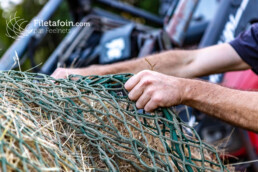
Hay Nets: Usage and Installation Precautions
Installing and using hay nets for horses requires certain precautions to ensure the safety and well-being of the animals
First, it is essential to choose a quality net, made from robust and resistant materials (we recommend polyamide or, even better, polyester). The mesh should be small enough to prevent horses from getting their hooves or teeth caught, but large enough to allow easy hay consumption.
When installing, make sure to secure the net at an appropriate height.
Make sure to install your hay net at an adequate height
Generally at the horse’s chest level or on the ground (in a feeder), to avoid excessive strain on the neck and back muscles. Ensure the net is securely attached and that the installation does not have sharp edges or protruding parts that could injure the animal.
Monitor the condition of your hay nets
It is also crucial to regularly check the condition of the net. Worn or damaged nets must be replaced or repaired to prevent any risk of injury. During use, monitor the horses for any signs of stress or abnormal behavior, such as difficulty eating or injuries around the mouth (which can occur due to poor quality nets).
Hay nets for a herd
To avoid conflicts between horses, especially in groups, it is recommended to place several hay nets in different locations. This allows each horse to have fair access to hay and reduces the risk of fights.
Good quality hay
Finally, ensure that the hay used is of good quality, free from mold and dust, to prevent respiratory and digestive problems. By following these precautions, you will contribute to the health and well-being of your horses while optimizing the use of hay nets.
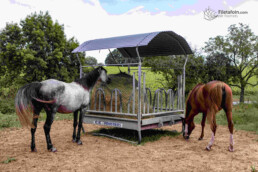
Different Hay Nets, Accessories, and Attachments
Feelnets hay nets are designed to meet the varied needs of horse owners. Feelnets offers a diverse range of hay nets, suitable for different sizes and shapes of hay bales, whether round or rectangular, or even loose hay.
Different Hay Nets, Accessories, and Their Prices:
1 – Nets for Round or Rectangular Bales
These nets are knotless, with a high-quality finish. The different prices for round bale nets are:
| Diameter | 30 mm Mesh | 45 mm Mesh | 65 mm Mesh | |
| 1m | €150 incl. VAT (€125 excl. VAT) | €135 incl. VAT (€112.50 excl. VAT) | €125 incl. VAT (€104.17 excl. VAT) | |
| 1.20m | €180 incl. VAT (€150 excl. VAT) | €140 incl. VAT (€116.67 excl. VAT) | €129 incl. VAT (€107.50 excl. VAT) | |
| 1.50m | €185 incl. VAT (€154.17 excl. VAT) | €144 incl. VAT (€120 excl. VAT) | €134 incl. VAT (€111.67 excl. VAT) | |
| 1.60m | €200 incl. VAT (€166.67 excl. VAT) | Available at Equidéos | €139 incl. VAT (€115.83 excl. VAT) | |
| 1.70m | €203 incl. VAT (€169.17 excl. VAT) | €160 incl. VAT (€133.33 excl. VAT) | €142 incl. VAT (€118.33 excl. VAT) | |
| 1.80m | €205 incl. VAT (€170.83 excl. VAT) | Available at Equidéos | €144 incl. VAT (€120 excl. VAT) | |
| 1.90m | €224 incl. VAT (€186.67 excl. VAT) | €175 incl. VAT (€145.83 excl. VAT) | €155 incl. VAT (€129.17 excl. VAT) | |
| 2m | €229 incl. VAT (€190.83 excl. VAT) | €180 incl. VAT (€150 excl. VAT) | €165 incl. VAT (€137.50 excl. VAT) |
2 – Sheet Nets:
These nets are knotless, with a neat edge and a 6 mm perimeter rope. The different prices for sheet nets are:
| Size | 30 mm Mesh | 45 mm Mesh | 65 mm Mesh | |
| 2 x 2 m | Available at Equideos | Available at Equideos | €47 incl. VAT (€39.17 excl. VAT) | |
| 2.50 x 2.50 m | €144 incl. VAT (€120 excl. VAT) | €85 incl. VAT (€70.83 excl. VAT) | €67 incl. VAT (€55.83 excl. VAT) | |
| 3 x 3 m | €186 incl. VAT (€155 excl. VAT) | €110 incl. VAT (€91.67 excl. VAT) | €90 incl. VAT (€75 excl. VAT) | |
| 3.50 x 3.50 m | €216 incl. VAT (€180 excl. VAT) | €149 incl. VAT (€124.17 excl. VAT) | €120 incl. VAT (€100 excl. VAT) | |
| 4 x 4 m | €278 incl. VAT (€231.67 excl. VAT) | €175 incl. VAT (€145.83 excl. VAT) | €150 incl. VAT (€125 excl. VAT) |
3 – Bag Nets
- Sewn on three sides and reinforced with a 6 mm perimeter rope, these nets feature a 30 cm flap to facilitate closure. It is also possible to request them with a drawstring closure. Photos are available: https://filetafoin.com/modeles-et-tarifs/
Bag nets can be designed with different mesh sizes on the front/back.
| Mesh Sizes | L 1 x H 0.90 m | L 1.50 x H 1 m | L 2 x H 1 m |
| 30 mm | €47 incl. VAT (€39.17 excl. VAT) | €64 incl. VAT (€53.33 excl. VAT) | €83 incl. VAT (€69.17 excl. VAT) |
| 45 mm | €42 incl. VAT (€35 excl. VAT) | €57 incl. VAT (€47.50 excl. VAT) | €77 incl. VAT (€64.17 excl. VAT) |
| 65 mm | €40 incl. VAT (€33.33 excl. VAT) | €54 incl. VAT (€45 excl. VAT) | €68 incl. VAT (€56.67 excl. VAT) |
| 30/45 mm | €46 incl. VAT (€38.33 excl. VAT) | Available at Equideos | €76 incl. VAT (€63.33 excl. VAT) |
| 45/65 mm | €42 incl. VAT (€35 excl. VAT) | €55 incl. VAT (€45.83 excl. VAT) | €66 incl. VAT (€55 excl. VAT) |
4 – Special Net for Palox
Delivered with its instructions and attachment system, this net optimizes the use of a palox as a feeder. A special palox hay net is designed for use with paloxes, which are large wooden or plastic crates primarily used for storing and transporting agricultural products. These nets are suitable for covering the hay contained in these paloxes, thereby reducing waste and slowing down hay consumption by horses or other animals. This ultra-easy-to-install system allows for safe use of a hay net in a palox. Closure is done with a drawstring.
| Standard size Palox (1 m x 1.20 m x 0.75 m) |
30 mm Mesh | 45 mm Mesh | 65 mm Mesh | |
| With its attachment system | €150 incl. VAT (€125 excl. VAT) | €115 incl. VAT (€95.83 excl. VAT) | €90 incl. VAT (€75 excl. VAT) |
5 – Accessories and Attachments:
Including automatic carabiners on stainless steel 314 plates (Sold with 2 stainless steel 4.5*50 mm 304 stainless steel screws) at a price of €6 incl. VAT (€5 excl. VAT)
Stainless Steel A4 Attachment Ring
50×40 mm plate, 45 mm inner ring diameter
| Unit Price | |
| €6 incl. VAT (€5 excl. VAT) |
Galvanized steel eye bolts, 8 x 80 mm
Load capacity 80kg
Eye bolt weight 10g
Diameter 8mm
Thread length 50mm
Overall length 120mm
Eye diameter 25mm
or 12 x 120 mm, as well as concrete anchors.
Which walls are the eye bolts suitable for?
Wood (requires pre-drilling and screwing)
Concrete (requires concrete anchors)
Brick (requires chemical anchoring)
Stone (requires chemical anchoring)
| Galvanized Steel Eye Bolt | |
| Dimensions in mm | Unit Price |
| 8 x 80, 22 mm inner diameter | €2 incl. VAT (€1.67 excl. VAT) |
| 12 x 120, 26 mm inner diameter | €3 incl. VAT (€2.50 excl. VAT) |
| Stainless Steel Eye Bolt | |
| Dimensions in mm | Unit Price |
| 8 x 80, 16 mm inner diameter | €2.50 incl. VAT (€2.08 excl. VAT) |
| Concrete Anchor | |
| Unit Price | |
| €0.60 incl. VAT (€0.50 excl. VAT) | |
| €1.88 incl. VAT (€1.57 excl. VAT) | |
Feelnets hay net prices vary depending on the size and model chosen. Custom-made nets, adapted to specific needs, may be more expensive, but offer a perfectly tailored solution for each situation.
By choosing Feelnets, you opt for superior quality products, designed in partnership with equestrian professionals. The polyester used is ultra-resistant, soft to the touch, and does not become rough over time, thus ensuring the comfort and safety of your animals.
Do not hesitate to request a personalized quote for specific dimensions or particular needs.

How to install my Feelnets hay net for round bales?
To easily install a hay net for a round bale, here are the steps to follow:
Ideally, prevent equids from trampling the hay net.
1 – Choose the net size
The net size depends on several factors, including the amount of hay to be distributed, the frequency of distribution, and whether you are using square bales or loose hay. Feelnets hay nets are available in different sizes, and even custom-made. Don’t forget to choose a net with a sufficiently large diameter to thread the bale through without difficulty. If the hay bales are poorly compressed, allow for an additional margin to facilitate net installation.
2 – Prepare the net:
Place the net directly onto the round bale or rectangular bale. Pull it on, as you would pull a sock onto your foot. Make sure the net is well-centered on the bale. Since our nets are not pre-formed, there is no specific way to put it on. Choose the direction that is easiest for you. If you have a tractor, you can move your hay bale with the Feelnets hay net already installed.
3 – Remove the strings
Remove the strings or net wrap that hold the hay. We recommend removing the strings or net wrap that secure the hay once you have placed it where you intend to feed it.
4 – Close the sliding knot
Feelnets hay nets are equipped with an easy closing system using a sliding knot. When you reach the end of the net, simply close the sliding knot to keep the hay in place. Remember to undo the knot at the end of the tie to avoid creating a loop that could be dangerous. Tuck any excess sliding tie inside the net to prevent it from hanging out.
To prevent wear and tear on the net and all risks of accident, we advise you to install your hay bale with the net in a hay feeder or any other device that prevents horses from trampling the hay net.
By following these steps, you should be able to install a hay net for a round bale easily and efficiently. If you have a tractor, the process will be even simpler.
The hay nets from www.filetafoin.com by www.feelnets.com are made of polyester, making them flexible, lightweight, and very easy to put on. Since they do not retain water, they will not become rigid in case of frost, nor heavy as they will not soak up water.
Happy installation!
10 Good Reasons to Use a Feelnets Hay Net
1 – Improved Digestive Health
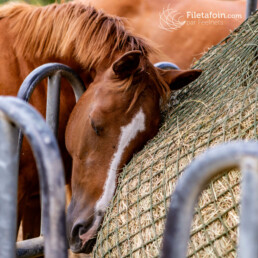
Hay nets encourage slow and continuous hay consumption, which promotes better digestion. Horses are less prone to prolonged fasting periods, thus avoiding health problems such as gastric ulcers or colic.
2 – Respiratory Disease Prevention
Respiratory Disease Prevention: Hay nets reduce dust and allergens in hay, preserving horses’ respiratory health.
3 – Preventing Overeating
Ideal for horses that benefit from free-choice hay, hay nets prevent overly rapid ingestion which can lead to digestive problems.
4 – Hay Savings
On average, 30% hay savings are achieved by using hay nets. They reduce waste by keeping the hay contained and clean.
5 – Comfort for Horses
The braided mesh of hay nets is pleasant to the touch, offering maximum comfort to horses.
6 – Knotless Polyester
Feelnets hay nets are made of knotless polyester, which makes them durable and long-lasting. Furthermore, polyester does not become rough and remains easy to handle, even when wet or in freezing weather.
7 – Simulating Natural Grazing
Horses constantly graze small amounts of grass throughout the day. Hay nets simulate this natural behavior by allowing slow and regular feeding
8 – Well-being and Performance
Hay nets contribute to the well-being of horses by ensuring appropriate feeding. They maintain an appropriate body weight and promote better nutrient assimilation.
9 – OEKO-TEX 100, Class I Certification
This certification guarantees that the net is free of substances harmful to human health and complies with strict ecological and safety standards.
10 – Ease of Transport and Storage
- Hay nets are practical for transporting and storing hay. They keep hay organized and ready for use.
10 – Professional Hay Nets
Designed by and for equestrian professionals, Feelnets are the result of extensive research and over 10 years of experience.
In conclusion, using hay nets is beneficial for the health and well-being of your horses, while also offering practical and economic advantages.
The polyester net material is a solid, ecological, and horse-health-friendly choice.
EMS and Hay Nets
Equine Metabolic Syndrome (EMS)
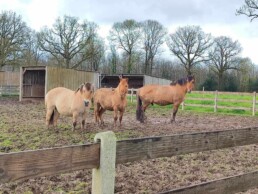
Equine Metabolic Syndrome (EMS) is a condition that affects many horses and ponies worldwide. It is characterized by a set of symptoms that include obesity, insulin resistance, laminitis, and lipid metabolism disturbances. EMS is often associated with an unsuitable diet and lack of exercise, making it a major concern for horse owners.

Horses with EMS often exhibit
abnormal fat deposits, particularly around
the crest of the neck. They also show signs of
insulin resistance, such as unexplained weight gain
despite a controlled diet.
Finally, they are susceptible to developing
episodes of laminitis.
The Benefits of Hay Nets
One of the most effective measures to help combat EMS is the use of a hay net. Indeed, limiting horses’ access to their food can help reduce their excessive consumption of calories and carbohydrates, which can help prevent obesity and stabilize their blood sugar. Furthermore, hay nets slow down the rate at which horses eat, which can promote better digestion and more efficient nutrient absorption.
Laminitis Prevention
By limiting horses’ access to their food, hay nets can also help prevent laminitis, a painful disease that affects horses’ feet and is often associated with EMS. By reducing calorie and carbohydrate intake, hay nets can help maintain a healthy body weight and prevent fat accumulation around internal organs, which can reduce pressure on the horse’s feet and limbs.
Improving Lipid Metabolism
Finally, the use of a hay net can also be beneficial for horses with lipid metabolism disturbances. By limiting horses’ access to their food, hay nets can help reduce their consumption of saturated fats and sugars, which can contribute to improving their lipid profile and reducing the risk of cardiovascular diseases.

Slow Feeding with Hay Nets
Slow Feeding in a Nutshell
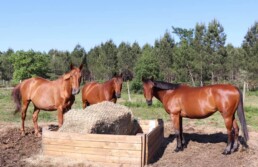
The practice of slow feeding, also known as controlled feeding, involves providing a constant amount of food to equids over a longer period. This method consists of setting up specific devices, such as hay nets, to slow down food consumption.
Why Use Slow Feeding to Feed Horses?
The benefits of slow feeding for equids are numerous. First, this practice allows for simulating the natural feeding behavior of these animals, which are predisposed to graze small quantities of grass throughout the day. By offering slow feeding, equids can return to a behavior that meets their physiological and behavioral needs.
Furthermore, the slow feeding promotes better digestion in equids. Horses are animals designed to spend most of their time eating low-energy vegetation. By mimicking this diet and limiting access to large quantities of calorie-rich foods, we can prevent digestive disorders such as obesity, colic, and gastric ulcers.
Finally, slow feeding can contribute to weight management in equids. Many horses and ponies are at risk of overweight and obesity, which can lead to health problems such as locomotor or metabolic disorders. By limiting food consumption and extending meal duration, animals can feel satiated longer and reduce the risk of excessive weight gain.
In conclusion, slow feeding, thanks to hay nets, offers numerous benefits for equids. By promoting controlled feeding and mimicking their natural behavior, horses and ponies can regain physiological and behavioral balance. In addition to promoting better digestion, slow feeding can contribute to weight management and the prevention of health problems.
How to Implement Slow Feeding?
Slow feeding, also known as controlled feeding, is a popular method used to feed equids, such as horses, ponies, and donkeys. This approach involves providing food in a more natural and slow manner, thus simulating their natural diet. There are several possible methods for practicing slow feeding, each with its advantages and disadvantages.
The most common method is the use of hay nets. These nets, also called slow feeding hay nets, limit access to food, thus forcing the animal to eat more slowly. The small mesh reduces the amount of food that can be taken at once, forcing the animal to pull the food through the mesh, which slows down the feeding process. This method also helps reduce hay waste and prevent health problems associated with overweight.https://filetafoin.com/comment-bien-installer-un-filet-a-foin-pour-chevaux/
Some equid owners prefer to use special feeders designed for slow feeding. These feeders have small holes that limit access to food, thus forcing the animal to eat more slowly. This allows for better digestion and prevents health problems such as gastric ulcers and colic.
Finally, some equid owners choose to divide the daily hay ration into several smaller meals, distributing them throughout the day. This method also allows the animal to feed more slowly, while mimicking its natural diet of frequent grazing.
In conclusion, slow feeding is a beneficial method for feeding equids. Slow feeding with hay nets allows equids to feed more slowly and enjoy better digestive health.
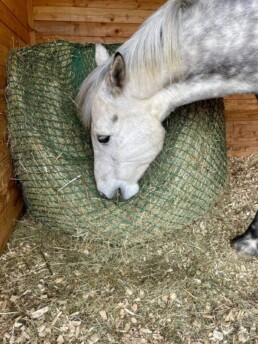
The benefits of using a hay net
The horse, a delicate animal
Horses have delicate metabolisms, requiring adequate nutrition to stay healthy and perform well. Horse owners often wonder how to provide a balanced and abundant diet for their equine companions. A useful method to facilitate forage intake is the use of hay nets, which offer numerous benefits for feeding horses.
Hay nets are devices specifically designed to contain and distribute hay. Unlike a traditional feeder, these nets are designed with mesh that allows the horse to eat hay more slowly and in small quantities at a time (for 30 mm and 45 mm mesh sizes. Choosing the right mesh size). This approach better simulates horses’ natural grazing behavior, where they constantly graze small amounts of grass throughout the day.
Hay nets encourage horses to eat slowly
One of the main advantages of using hay nets is that they encourage slow and continuous hay consumption. Horses have a sensitive digestive system and require regular feeding for optimal digestion. When fed with hay nets, horses are less prone to prolonged fasting periods, which can lead to health problems such as gastric ulcers or colic.
Furthermore, eating hay more slowly is beneficial for horses that tend to gobble their food quickly. These horses are often more prone to digestive problems because they ingest food too quickly, and their digestive system doesn’t have enough time to process it properly. Hay nets encourage slower feeding, allowing the horse to chew and digest its food better, thus ensuring better nutrient assimilation.
Hay Savings
Horse owners also appreciate the use of hay nets for practical reasons. Hay nets reduce hay waste by keeping it contained. Horses can nibble on the hay without trampling or soiling it, which means less wasted hay. Additionally, hay nets facilitate the transport and storage of hay, keeping it well-organized and ready for use.
In conclusion, the use of hay nets offers numerous benefits for optimally feeding horses. They promote slow and regular feeding, which improves horses’ digestive health and helps maintain an appropriate body weight. Furthermore, hay nets reduce hay waste and simplify the management of horses’ diets. Horse owners should therefore consider adopting this method to ensure the well-being and performance of their equine companions.