


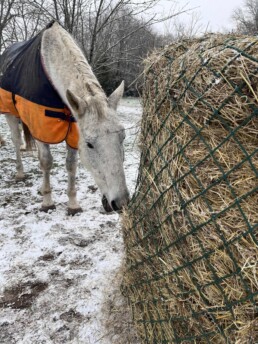
What's the benefit of using a hay net for horses in winter?
Winter, a Challenging Season
Winter is a demanding time for our equine friends, and proper management of their diet becomes crucial for maintaining their health and well-being. Using a hay net during this cold season can be extremely beneficial for horses, offering a practical and effective solution to meet their nutritional needs.
One of the main advantages of using a hay net in winter is the optimal management of horses’ feeding. Normally, horses have access to grass throughout the day, but in winter, the availability of fresh grass decreases. Horse owners often face the challenge of providing sufficient hay to meet their animals’ nutritional needs.
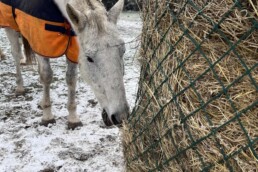
Hay nets serve as a practical solution here by allowing control over hay access, preventing waste, and ensuring regular distribution throughout the day.
The Hay Net to Combat Obesity and Boredom
By limiting hay access, the hay net also helps prevent obesity in horses. In winter, when physical activity can be reduced due to harsh weather conditions, the risk of unwanted weight gain increases. The hay net encourages slower feeding, better simulating the natural grazing habits of horses. This promotes better digestion and limits the risks of obesity-related metabolic problems.
Furthermore, using a hay net can help prevent boredom in horses confined during winter. With limited access to the outdoors and pastures, horses can quickly become bored, which can lead to undesirable behaviors such as cribbing or developing vices. By providing hay through a net, horses are given a natural occupation, encouraging them to spend more time eating, which helps reduce stress and boredom.
The Hay Net: Against Waste and for Better Dental Health
Another crucial advantage of using a hay net in winter is the reduction of waste. By distributing hay through a net, horses are less likely to trample or soil their food. This minimizes losses, saving hay and reducing costs associated with feeding during the winter season. Moreover, by reducing waste, we also contribute to environmental preservation by minimizing the amount of discarded hay.
Finally, using a hay net in winter can have benefits for horses’ dental health. Chewing hay throughout the day promotes natural tooth wear, thus helping to maintain good oral health. Dental problems are common in horses, and a diet based on hay distributed through a net can be a simple preventive method to avoid these issues.
In conclusion, using a hay net in winter offers numerous advantages for managing horses’ diets. By controlling hay access, preventing obesity, combating boredom, reducing waste, and promoting dental health, the hay net emerges as a versatile and essential solution to ensure the well-being of horses during the winter season. Horse owners should consider this option as a beneficial practice to keep their equine companions healthy and happy throughout the winter.

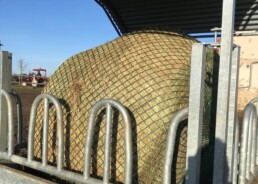
Our Material Choice: Polyester
Polyester: Ultra-Durable
The filetafoin.com polyester hay net from Feelnets offers several advantages over other existing materials, particularly its strength.
. Durability: Polyester is a robust material that withstands wear and tear and the elements well. It can be used for several seasons without degrading. The lifespan of outdoor polyester is estimated at around twenty years.
. UV Resistance: Polyester is also resistant to the sun’s ultraviolet rays. This means that the polyester hay net will not fade or weaken due to sun exposure.
Polyester has a very long lifespan and is less prone to degradation caused by UV rays, mold, moisture, etc.
Polyester: Ease of Use
. Lightweight: Compared to other materials, the polyester hay net is lighter. This makes it easier to install and transport.
. Ease of Use: Polyester hay nets are generally lightweight and easy to handle, making them practical to use when filling and closing hay bales. The filetafoin.com polyester net from Feelnets is a flexible material, easy to handle.
. Water Resistance: Polyester is naturally resistant to moisture. This means that the polyester hay net will not deteriorate if exposed to rain or humidity. It will not retain water, so it won’t freeze. It will remain flexible and lightweight. The hay will not be damaged by contact with the polyester net.
. Easy Maintenance: The polyester hay net is easy to clean. You can wash it by hand, with a pressure washer*, or in a machine without fear of damaging it.
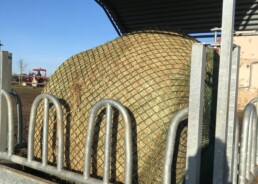
Polyester Hay Nets Save Money
Polyester hay nets are cost-effective because they last longer than other materials. In addition to the hay savings achieved by using a hay net.
Peace of Mind with Our Polyester Nets
. Safety: Polyester hay nets are more resistant than nets made of other materials. This is particularly important for animal safety, as a stronger net reduces the risk of tearing and fraying. There is no risk of material ingestion.
The polyester in Feelnets.com hay nets is Oeko-Tex certified. Therefore, they contain no harmful substances. Considered a textile, polyester is 100% recyclable.
. Eco-friendly: Feelnets hay nets are 100% recyclable.
. Respectful of horse physiology. Polyester is a material that does not become rough, thus it respects the gums, teeth, lips, and whiskers of equids;
The polyester used for Feelnets.com hay nets is a strong and durable fiber. It is used for its ability to support the weight of hay bales without deforming or tearing. Polyester is also resistant to weathering and degradation caused by prolonged sun exposure. This makes it an ideal choice for users looking for a reliable material for their hay nets.

Equine Feeding
Feeding Horses in the Wild
Let’s try to understand the ideal way to feed a horse by observing them in the wild. Horses have a delicate metabolism, and a good diet can prevent certain equine pathologies, some of which can be very serious or even fatal. Ideally, we should try to mimic as closely as possible how horses eat in their natural environment.
In the wild, horses live on plains where they fulfill their needs for water, food, shelter, and companionship. Horses spend up to 18 hours a day grazing. The primary activity of a wild horse is foraging for food, which they graze in small quantities, almost continuously throughout the day.
Feeding Our Domesticated Horses
Our captive horses live in enclosed spaces, often without enough grass to meet their dietary needs. Horses are frequently fed in multiple portions per day, with feeds such as cereals or pellets and hay distributed in bales. In stalls, it’s common for horses to be fed 2 to 3 times daily. The feed is consumed in a few minutes, and a pile of hay placed on the ground doesn’t last long either – certainly not long enough given the horses’ needs. In paddock paradise setups or pastures, we increasingly find horses fed free-choice hay. The horse then eats for as long as it wants, but we observe that it eats too much.
Hay serves as an alternative when there’s a lack of grass. In the pursuit of animal welfare, we strive to find a feeding method that best mimics what a horse needs in its natural environment. Allowing them free access to hay is one such alternative to insufficient grass. However, when hay is in piles, it’s easy to eat, and horses take large mouthfuls, which isn’t ideal. If a horse is fed a hay ration that isn’t free-choice, it will eat its portion too quickly, leading to a long wait until the next forage distribution. Hay provided without a net can lead to overeating, and horses tend to gorge themselves, especially when it’s offered free-choice.
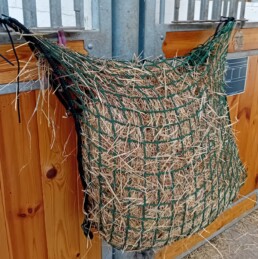
Today, free-choice hay is becoming more widely accepted because we now understand that horses need to eat for extended periods. The concept of placing hay in a net with an appropriate mesh size will slow down hay consumption, thereby increasing the horse’s chewing time.
Slow Feeding for Optimal Nutrition
Slow feeding is not frustrating for horses; they will spend more time eating hay. It’s a feeding method better suited to their physiological needs. Slow feeding also helps horses avoid boredom. Thanks to hay nets, chewing time will be better distributed throughout the day. The horse will not be anxiously awaiting its next ration. Hay nets will improve their mental well-being and morale. Our domesticated horses need to eat for as long as wild horses do for their overall well-being. Reducing this time could lead to stress, stomach ailments like ulcers, tics, and behavioral issues.
Hay nets, and thus slow feeding, will also allow equids to self-regulate, preventing them from becoming overweight. We know that an overweight horse is at risk of developing serious health problems.
The benefits of slow feeding are therefore numerous. In the pursuit of animal welfare, it is clear that hay nets offer only advantages.

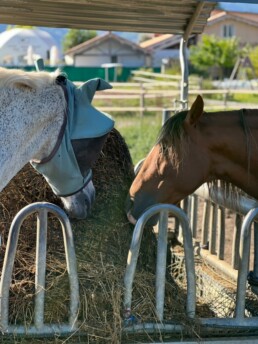
The benefits of Feelnets hay nets for horse health and well-being
Reducing Hay Waste
Hay nets are an innovative solution for optimizing hay management in stables. By preventing horses from pulling out large quantities of hay at once, these nets significantly reduce waste. Unlike traditional methods, where a substantial amount of hay is often trampled and soiled, hay nets keep hay clean and accessible in small portions. Horses will spread less hay on the ground. This hay saving not only leads to reduced costs for owners but also to more efficient feeding that respects equine physiology.
Feelnets offers a wide range of hay net sizes and shapes, to best adapt to each individual’s hay distribution methods.
Positive Impact on Digestion and Health
Using hay nets offers significant benefits for horses’ digestive health. By mimicking natural grazing, the nets encourage horses to eat slowly, promoting more thorough chewing and better salivation. This contributes to more efficient digestion and optimal nutrient absorption. Additionally, slowing down hay consumption helps prevent colic and other common digestive disorders in horses. By integrating hay nets into their feeding routine, horse owners can improve the overall health and well-being of their equines.
Weight Management and Obesity Prevention
Hay nets also play a crucial role in managing horses’ weight. By controlling access to hay and encouraging gradual consumption, these nets help prevent obesity, an increasingly common problem in domestic horses. Obesity can lead to a multitude of complications, including Equine Metabolic Syndrome (EMS) and laminitis. Hay nets significantly reduce the “greedy eater” effect. Horses will no longer be able to take large mouthfuls of hay. This preventive measure is essential to avoid long-term health problems and ensure an active and comfortable life for horses.
Preventing Respiratory Diseases
Another important advantage of hay nets is the reduction of dust exposure for horses. By keeping the hay compact and preventing it from scattering or horses burying their noses in it, hay nets reduce the amount of dust inhaled by horses. Less dust means less risk of developing respiratory diseases such as emphysema, a common condition in horses. By integrating Feelnets hay nets into their daily diet, owners can help preserve their horses’ lung health and provide them with a healthier environment.
Satisfied Owner Testimonials
Many horse owners who have adopted Feelnets hay nets report notable improvements in their animals. According to them, horses appear more relaxed and satisfied, exhibiting fewer behaviors related to feeding stress. Furthermore, owners have observed a reduction in hay purchase costs due to decreased waste. This positive feedback highlights the effectiveness of hay nets as a tool for feed management and equine well-being. For those looking to provide their horses with a healthy and economical diet, Feelnets hay nets are a proven and recommended solution.