


Feeding Horses in the Wild
Let’s try to understand the ideal way to feed a horse by observing them in the wild. Horses have a delicate metabolism, and a good diet can prevent certain equine pathologies, some of which can be very serious or even fatal. Ideally, we should try to mimic as closely as possible how horses eat in their natural environment.
In the wild, horses live on plains where they fulfill their needs for water, food, shelter, and companionship. Horses spend up to 18 hours a day grazing. The primary activity of a wild horse is foraging for food, which they graze in small quantities, almost continuously throughout the day.
Feeding Our Domesticated Horses
Our captive horses live in enclosed spaces, often without enough grass to meet their dietary needs. Horses are frequently fed in multiple portions per day, with feeds such as cereals or pellets and hay distributed in bales. In stalls, it’s common for horses to be fed 2 to 3 times daily. The feed is consumed in a few minutes, and a pile of hay placed on the ground doesn’t last long either – certainly not long enough given the horses’ needs. In paddock paradise setups or pastures, we increasingly find horses fed free-choice hay. The horse then eats for as long as it wants, but we observe that it eats too much.
Hay serves as an alternative when there’s a lack of grass. In the pursuit of animal welfare, we strive to find a feeding method that best mimics what a horse needs in its natural environment. Allowing them free access to hay is one such alternative to insufficient grass. However, when hay is in piles, it’s easy to eat, and horses take large mouthfuls, which isn’t ideal. If a horse is fed a hay ration that isn’t free-choice, it will eat its portion too quickly, leading to a long wait until the next forage distribution. Hay provided without a net can lead to overeating, and horses tend to gorge themselves, especially when it’s offered free-choice.
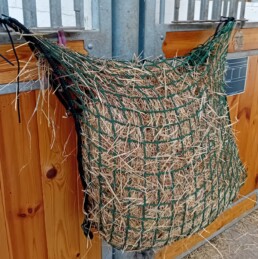
Today, free-choice hay is becoming more widely accepted because we now understand that horses need to eat for extended periods. The concept of placing hay in a net with an appropriate mesh size will slow down hay consumption, thereby increasing the horse’s chewing time.
Slow Feeding for Optimal Nutrition
Slow feeding is not frustrating for horses; they will spend more time eating hay. It’s a feeding method better suited to their physiological needs. Slow feeding also helps horses avoid boredom. Thanks to hay nets, chewing time will be better distributed throughout the day. The horse will not be anxiously awaiting its next ration. Hay nets will improve their mental well-being and morale. Our domesticated horses need to eat for as long as wild horses do for their overall well-being. Reducing this time could lead to stress, stomach ailments like ulcers, tics, and behavioral issues.
Hay nets, and thus slow feeding, will also allow equids to self-regulate, preventing them from becoming overweight. We know that an overweight horse is at risk of developing serious health problems.
The benefits of slow feeding are therefore numerous. In the pursuit of animal welfare, it is clear that hay nets offer only advantages.